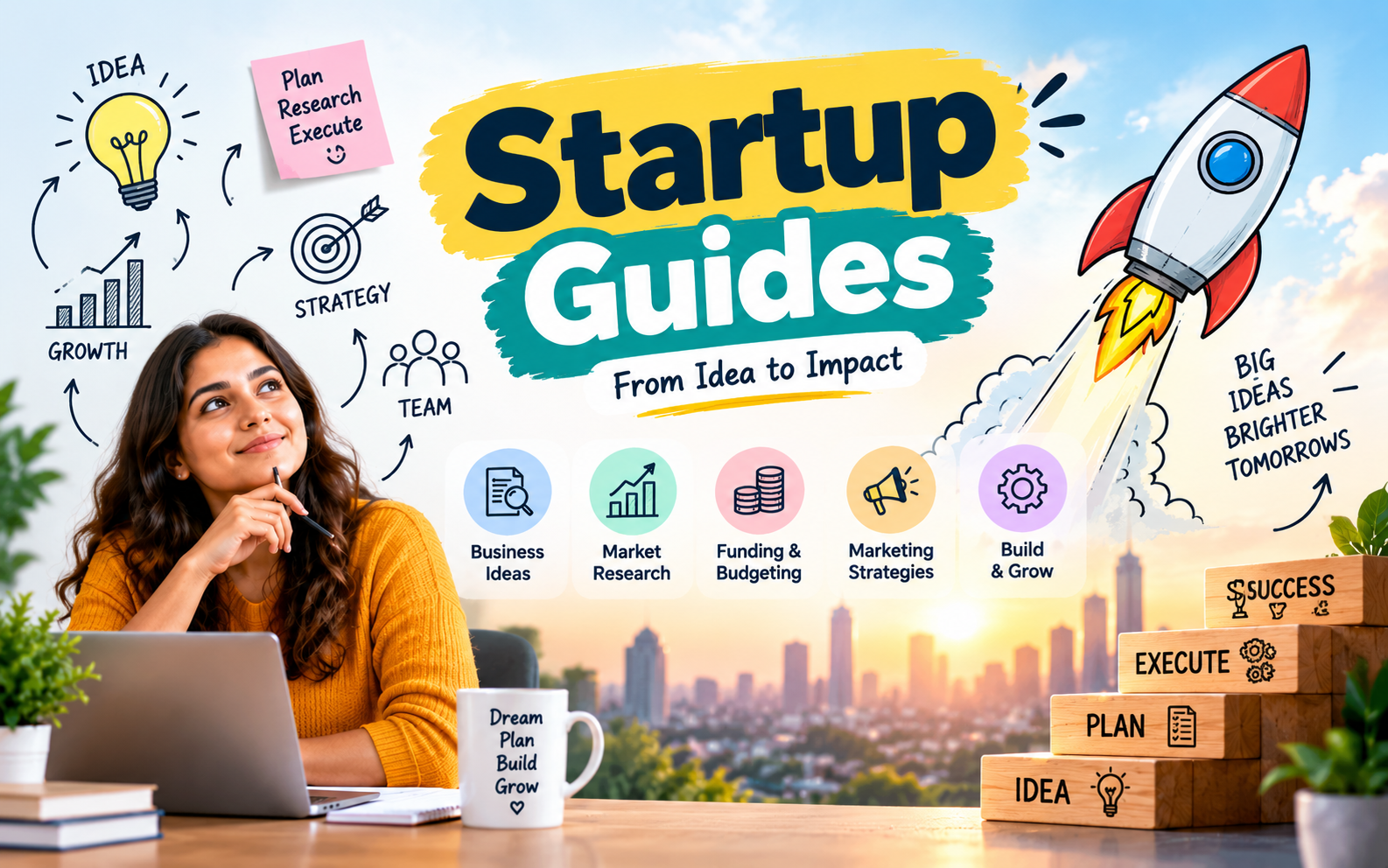
Startup Guides: From a Bold Idea to a Business That Actually Works
Every successful startup begins with a question: What if there were a better way to do this?
Imagine sitting in a small room with a notebook, a laptop, and an idea that refuses to leave your mind. You can already picture the company name, the website, the product, and the moment your first customer says, “This is exactly what I needed.”
But between that exciting vision and a real, profitable business lies a journey filled with decisions, experiments, mistakes, and unexpected opportunities.
Welcome to the world of startups.
Building a startup is not simply about launching a website, raising money, or becoming the next big name in the industry. It is about solving a real problem, understanding people, managing limited resources, and creating something customers are willing to pay for.
This startup guide will help you turn an idea into a practical business plan, avoid common early mistakes, and build a foundation for sustainable growth.
1. Stop Falling in Love With Your Idea. Fall in Love With the Problem.
One of the biggest mistakes aspiring entrepreneurs make is spending months perfecting a product before finding out whether anyone actually needs it.
An idea may sound brilliant to you, but a business becomes viable when it solves a problem people genuinely care about.
Consider three examples:
A student struggles to find affordable career guidance.
A small shop owner wants to sell online but cannot afford a complicated ecommerce website.
A local service provider receives enquiries through WhatsApp but loses track of customers and follow-ups.
Each situation represents a potential business opportunity.
The key question is not, “Can I build this?” It is, “Who has this problem, how are they solving it today, and would they pay for a better solution?”
Your first startup exercise: Speak to 10–15 potential customers. Ask about their current challenges, what they have already tried, how much the problem costs them, and what an ideal solution would look like.
Listen more than you pitch. Real customer conversations can reveal opportunities that hours of brainstorming may never uncover.
2. Find Your Business Model Before You Spend Your Savings
A startup needs more than an attractive product. It needs a clear way to generate revenue.
Your business model explains who pays you, what they pay for, and how frequently you earn.
Here are several common models worth exploring.
Service-based business: Offer services such as website development, digital marketing, consulting, design, or business automation. This can be a practical starting point because you may be able to begin with existing skills and relatively low upfront investment.
Subscription business: Customers pay monthly or annually for ongoing access to software, content, tools, or services. Recurring revenue can improve predictability, but customers must continue receiving value.
Ecommerce business: Sell physical or digital products through your own website, marketplaces, or other sales channels. Remember to account for product costs, shipping, returns, advertising, and inventory.
Marketplace business: Connect buyers and sellers and earn through commissions, listing fees, or subscriptions. Marketplaces can be difficult to launch because both sides need a reason to participate.
Freemium business: Offer a basic product for free and charge for advanced features. This model works only when enough free users convert to paying customers or create another sustainable source of value.
Before choosing a model, estimate how much it costs to acquire a customer, serve that customer, and maintain the business.
Revenue is important. Profitability and cash flow determine whether you can keep going.
3. Build a Tiny Version Before Building the Big Dream
You do not need a complete application, a large office, or a team of 20 people to test a business idea.
Start with a minimum viable product (MVP): the simplest version of your offering that allows you to test the most important assumptions.
For example:
Planning a food delivery startup? Begin with a small delivery area and a limited menu.
Building a business software platform? Test the core workflow with a few real businesses before developing every feature.
Launching a clothing brand? Test a small collection before ordering hundreds of units.
Starting a consulting service? Offer a clearly defined paid package before building an elaborate website.
An MVP is not an excuse to provide a poor customer experience. It should solve one important problem reliably while avoiding unnecessary complexity.
The objective is to learn quickly and inexpensively.
A useful rule: If customers cannot explain why they need your product after trying it, adding more features may not solve the real problem.
4. Create a Startup Budget That Reflects Reality
Many startups struggle not because their ideas are bad, but because they underestimate the cost of operating a business.
Your budget should include more than the price of developing a product.
Think about:
Business registration and professional advice
Product development, hosting, software, and equipment
Marketing, sales, and customer acquisition
Salaries, freelancers, and contractor payments
Inventory, packaging, delivery, and returns
Accounting, taxes, and compliance
Customer support and ongoing maintenance
Emergency funds for unexpected expenses
Separate one-time costs from recurring monthly expenses. Then estimate how much money you need before the business can support itself.
For example, if your startup spends ₹80,000 each month and earns ₹50,000 in monthly revenue, it has a ₹30,000 monthly operating shortfall before any additional costs not included in those figures.
This is why cash flow matters. A business can make sales and still run out of money if payments arrive late while expenses must be paid immediately.
Try to maintain a realistic cash reserve and review your finances every month. Avoid borrowing heavily simply to make the business look bigger than it is.
5. Your First 10 Customers Matter More Than Your First 10,000 Followers
Social media followers can create visibility, but visibility does not automatically pay the bills.
Your early customers teach you how people discover your product, what convinces them to buy, what makes them hesitate, and what would make them recommend you.
Start with direct, focused customer acquisition.
Use your existing network. Tell relevant contacts what problem you solve and ask whether they know someone who might benefit.
Make a specific offer. Instead of saying, “We provide all digital services,” explain the outcome: “We help small retailers launch an online store with product listings and payment integration.”
Show evidence. Demonstrations, case studies, samples, testimonials used with permission, and honest results can make your offer more credible.
Follow up professionally. Many sales are lost because nobody follows up after the first conversation. Maintain a simple record of enquiries, discussions, proposals, and next steps.
Ask why customers choose you. Their answers can improve your product positioning, pricing, and marketing.
Your first customers are not merely sources of revenue. They are an opportunity to understand the market before spending heavily to reach it.
6. Marketing Is Not About Being Everywhere
A new startup can easily become distracted by Instagram, LinkedIn, YouTube, paid advertisements, email marketing, influencer campaigns, and every new platform that appears.
The better approach is to identify where your target customers already spend time and choose one or two channels you can manage consistently.
For a business selling services to other companies, direct outreach, referrals, LinkedIn, and useful industry content may be effective.
For a consumer product, short-form videos, creator partnerships, search traffic, and relevant marketplaces may deserve attention.
For a specialised software product, educational articles, product demonstrations, niche communities, and targeted outreach may work better than broad advertising.
Start by answering three questions:
Who is the exact customer you want to reach?
What message would make that customer pay attention?
What action should they take after seeing your marketing?
Track enquiries, conversion rates, acquisition costs, and actual revenue—not just views and likes.
Marketing should be an experiment. Test one message, measure the result, and improve it before increasing the budget.
7. Choose Technology That Supports the Business, Not Your Ego
Technology can help a startup move faster, but complicated systems can also consume time and money before the business has proved its value.
A new company might need only a simple website, a reliable payment method, a spreadsheet or basic CRM, and a professional email address.
As demand grows, the business may need automation, analytics, a customer portal, mobile applications, or more advanced infrastructure.
Choose technology based on the actual problem.
Before building custom software, ask:
Can an existing tool handle the requirement?
Does this feature directly improve customer value or revenue?
Will the business be able to maintain the system?
Is the technology secure and suitable for the data being handled?
Can the product be tested with a simpler version first?
Artificial intelligence can help with research, drafting, customer support workflows, data analysis, and repetitive tasks. However, important business decisions, financial calculations, legal requirements, and customer-facing claims still need appropriate human review.
The smartest startup is not necessarily the one with the most technology. It is the one that uses technology to deliver value efficiently.
8. Build a Small Team With Clear Responsibilities
Hiring too quickly can place pressure on a startup's finances. Doing everything alone forever can create a different problem: the founder becomes a bottleneck.
Begin by identifying the activities that are essential to your business.
Depending on the company, these might include product development, sales, customer support, operations, and finance.
Some tasks can initially be handled by the founder, while specialist work may be outsourced when appropriate. As demand becomes more consistent, consider hiring for responsibilities that directly improve delivery, revenue, or customer experience.
When bringing people on board:
Define responsibilities and expected outcomes.
Agree on communication and decision-making processes.
Document important workflows.
Set realistic deadlines.
Encourage people to identify problems early.
Review performance using meaningful results rather than hours alone.
A startup does not need a large team to operate professionally. It needs people who understand the goal and know what they are responsible for delivering.
9. Understand the Legal and Compliance Side Early
Legal and regulatory requirements depend on your business structure, industry, location, customers, and revenue.
In India, entrepreneurs may need to consider business registration, tax obligations, invoicing, contracts, employment requirements, intellectual property, consumer protection, privacy, and industry-specific permissions.
For eligible businesses, recognition under the Startup India initiative may provide access to certain benefits, subject to applicable criteria and approval. However, not every newly formed business automatically qualifies.
Before accepting investment, signing major contracts, collecting sensitive customer information, or entering a regulated industry, seek suitable professional advice.
A few practical steps can reduce avoidable risk:
Use written agreements that clearly define deliverables, payments, and ownership.
Protect customer information and restrict unnecessary access.
Keep financial and business records organised.
Check whether your business needs specific registrations or licences.
Review ownership of code, designs, brand names, and other intellectual property.
Understand tax and reporting deadlines relevant to your business.
Compliance may not feel as exciting as launching a new feature, but it helps protect the business as it grows.
10. Track Five Numbers That Tell You What Is Really Happening
Startup founders often become busy without knowing whether the business is improving.
You do not need dozens of dashboards at the beginning. Start with a small set of useful metrics.
1. Monthly revenue: How much money is the business generating?
2. Gross margin: How much remains after the direct costs of delivering the product or service?
3. Customer acquisition cost: How much are you spending to acquire a customer through a particular channel?
4. Conversion rate: What proportion of qualified prospects take the next desired action, such as making a purchase?
5. Cash runway: How long can the business continue operating with its available cash at the current rate of net cash outflow?
Choose metrics that fit your business model. A subscription software company, an ecommerce store, and a consulting firm will not measure success in exactly the same way.
Review these numbers regularly, identify what changed, and decide what to do next.
11. A Practical 30-Day Startup Launch Plan
If you are starting from zero, avoid trying to complete everything in the first week. Use the first month to test whether your idea deserves more investment.
Days 1–7: Discover the problem
Choose one customer group.
Identify a specific problem worth solving.
Speak to potential customers.
Research competing products and existing alternatives.
Write down the strongest evidence you discover.
Days 8–14: Design the offer
Define the main benefit of your product or service.
Choose a simple business model and initial price.
Estimate setup costs and monthly expenses.
Create a basic demonstration, sample, landing page, or prototype.
Ask potential customers for feedback.
Days 15–21: Test the market
Contact suitable prospects.
Demonstrate the offer.
Ask for a paid pilot, preorder where appropriate, or another meaningful commitment.
Record objections and unanswered questions.
Improve the offer based on what you learn.
Days 22–30: Review and decide
Review customer responses and any sales.
Calculate basic costs and revenue.
Identify the marketing channel that produced the strongest results.
Fix the most important customer experience problems.
Decide whether to continue, change the approach, or test a different problem.
Thirty days may not be enough to build a profitable company, and some industries require much longer validation. The aim is to replace assumptions with evidence and make the next decision more intelligently.
12. The Biggest Startup Mistakes—and What to Do Instead
Mistake: Waiting for everything to be perfect.
Better approach: Launch a reliable, limited version and improve it through customer feedback.
Mistake: Spending heavily before validating demand.
Better approach: Test willingness to pay before committing to major expenses.
Mistake: Copying competitors without understanding customers.
Better approach: Find a specific customer problem you can solve differently or more effectively.
Mistake: Confusing revenue with profit.
Better approach: Track direct costs, operating expenses, cash flow, and margins.
Mistake: Treating every new idea as a priority.
Better approach: Choose one major objective at a time and finish the most important work first.
Mistake: Giving up after the first rejection.
Better approach: Look for patterns in customer feedback and distinguish between a weak offer, the wrong audience, and a genuine lack of demand.
Mistake: Ignoring personal well-being.
Better approach: Build sustainable routines, maintain relationships, and recognise when you need help. Constant exhaustion is not a reliable business strategy.
Final Thoughts: Start Small, Learn Fast, Build Something Valuable
A startup is not built in a single moment of inspiration. It grows through hundreds of decisions: the customer you choose to serve, the feature you decide not to build, the sale you follow up on, and the mistake you learn from instead of repeating.
You do not need a famous investor, a perfect business plan, or a massive launch to begin. You need a real problem, a thoughtful first solution, a willingness to listen, and enough discipline to manage your resources.
Start with one problem. Find a few people who experience it. Offer a practical solution. Learn from the response. Improve what works and change what does not.
Your first goal is not to build a huge company. It is to prove that you can create something valuable enough for real customers to choose.
That is where a startup stops being an idea and starts becoming a business.


Comments (0)
No comments yet. Be the first to comment below!
Leave a Comment
Your email address will not be published. Required fields are marked *