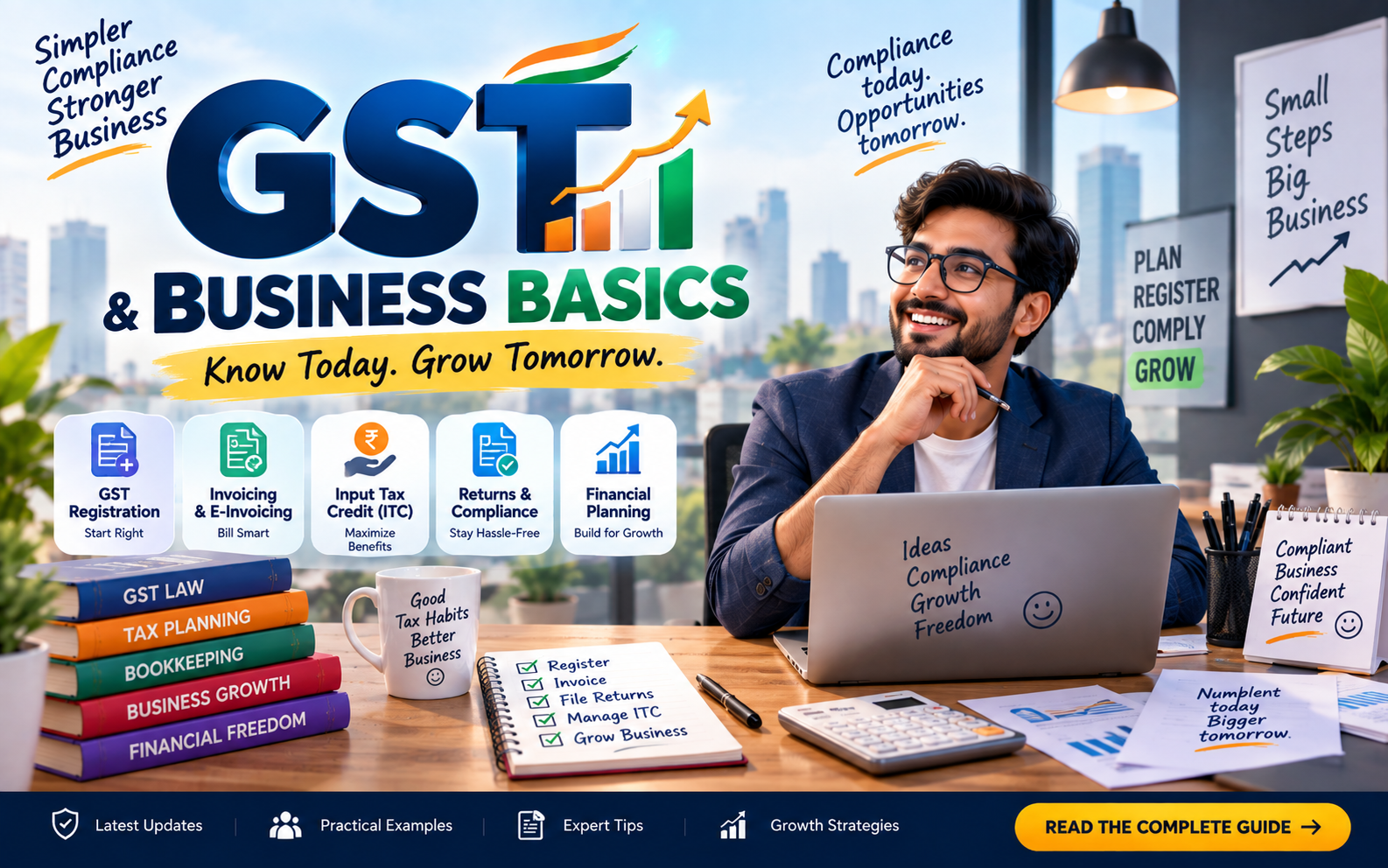
GST and Business Basics: A Practical Guide for Building a Strong Business
<h2>GST and Business Basics: A Practical Guide for Building a Strong Business</h2>
<p>Starting a business is exciting until the paperwork starts piling up.</p>
<p>One day you are thinking about your product, customers and marketing. The next day you are looking at invoices, GST, bookkeeping, bank statements, expenses, tax returns and compliance. For many small business owners, the numbers side of the business feels more complicated than the business itself.</p>
<p>The good news is that you do not need to become an accountant to understand your business finances. You do need to understand the basics well enough to know what is happening with your money and when professional help is necessary.</p>
<p><strong>GST and business basics</strong> are a good place to start.</p>
<p>Whether you run a shop, agency, consultancy, manufacturing unit, online store, restaurant, service company or freelance business, having a basic understanding of taxation and financial records can prevent many avoidable problems later.</p>
<h2>What Is GST?</h2>
<p>GST stands for Goods and Services Tax. It is an indirect tax applied to supplies of goods and services under India's GST framework.</p>
<p>For a business owner, the easiest way to understand GST is to think about the tax journey attached to a sale. When a registered business makes a taxable supply, it may collect GST from its customer and later account for that tax through the GST system, subject to the applicable rules.</p>
<p>The actual GST treatment depends on what you sell, where the supply takes place, who your customer is, the applicable classification and other conditions.</p>
<p>That last part matters. Two businesses can have similar sales figures but completely different GST obligations because their products, services, customers or transaction structures are different.</p>
<h2>Why Business Owners Should Understand GST</h2>
<p>GST is not something that should be looked at only when a return is due.</p>
<p>Your GST decisions can affect pricing, invoices, cash flow, purchasing, accounting and relationships with customers and suppliers.</p>
<p>Suppose you sell a service for ₹1,00,000 and GST is applicable. The amount shown on the invoice, the amount collected from the customer and the amount eventually payable after eligible input tax adjustments are separate concepts.</p>
<p>If a business owner treats the entire amount received in the bank account as income available for spending, the business can run into a cash-flow problem when tax payments become due.</p>
<p>This is why good financial habits start with separating business money into clear categories.</p>
<h2>Business Revenue Is Not the Same as Profit</h2>
<p>This is one of the first concepts every new entrepreneur should understand.</p>
<p>Revenue is the money generated from sales. Profit is what remains after eligible business expenses and other costs are accounted for.</p>
<p>A company can have high revenue and still struggle financially.</p>
<p>Imagine a business that generates ₹20 lakh in sales during a year. It sounds impressive. But if the business spends ₹15 lakh on inventory, salaries, rent, advertising, software, logistics and other operating costs, the amount left is very different from the original sales figure.</p>
<p>GST can add another layer because tax collected from customers should not automatically be treated as business profit.</p>
<p>Good bookkeeping helps you see the difference.</p>
<h2>Choose the Right Business Structure</h2>
<p>Before worrying about GST returns, think about the legal structure of the business.</p>
<p>Depending on the situation, a business may operate as a proprietorship, partnership, limited liability partnership, private limited company or another legally recognised structure.</p>
<p>The choice can affect taxation, liability, compliance, ownership, investment and how the business grows.</p>
<p>A small individual service provider may have different requirements from a company with several shareholders and employees.</p>
<p>There is no universal structure that works for every entrepreneur. The right choice depends on the business model, expected turnover, number of owners, risk exposure and future plans.</p>
<p>If you are starting a business seriously, it is worth discussing the structure with a qualified professional before making the decision.</p>
<h2>When Does a Business Need GST Registration?</h2>
<p>GST registration is one of the first areas where business owners should avoid relying on assumptions.</p>
<p>Registration requirements can depend on turnover, the nature of supplies, the state, the type of business and specific situations covered by GST law.</p>
<p>There are also cases where registration requirements can apply even when a business owner believes the turnover is relatively small.</p>
<p>For example, businesses involved in certain types of inter-State supplies, e-commerce-related transactions or specified categories of taxable activity may have additional considerations.</p>
<p>This is why simply asking, "My turnover is small, so do I need GST?" may not always produce the correct answer.</p>
<p>Check the current rules applicable to your exact business model before deciding whether registration is required.</p>
<h2>GSTIN: What Is It?</h2>
<p>Once a business is registered under GST, it receives a GST Identification Number, commonly called a GSTIN.</p>
<p>The GSTIN becomes an important identifier for GST-related transactions and compliance.</p>
<p>It should appear on relevant business documents and invoices according to the applicable rules.</p>
<p>Keeping your GST registration information accurate is important. Changes to business details, additional places of business, authorised signatories or other registration information may require updates through the GST system.</p>
<h2>Understanding GST Invoices</h2>
<p>An invoice is more than a document asking the customer for payment.</p>
<p>For a GST-registered business, a properly prepared tax invoice can form an important part of the transaction record.</p>
<p>Depending on the transaction, an invoice may contain information such as:</p>
<ul> <li>Supplier details</li> <li>Customer details</li> <li>GSTIN where applicable</li> <li>Invoice number</li> <li>Invoice date</li> <li>Description of goods or services</li> <li>HSN or SAC information where applicable</li> <li>Taxable value</li> <li>Applicable GST rate</li> <li>CGST, SGST/UTGST or IGST amounts as applicable</li> <li>Total invoice value</li> </ul>
<p>Businesses should avoid creating invoices casually or changing formats without understanding the compliance requirements.</p>
<p>Your invoice system should also match your accounting records.</p>
<h2>HSN and SAC Codes</h2>
<p>HSN and SAC classifications help identify goods and services for GST purposes.</p>
<p>HSN generally relates to goods, while SAC is used for services.</p>
<p>Correct classification matters because the classification can affect the applicable tax treatment, reporting and invoice information.</p>
<p>A common mistake is choosing a code simply because the description sounds similar.</p>
<p>If you sell multiple products or provide specialised services, classification should be reviewed carefully rather than guessed.</p>
<h2>CGST, SGST and IGST Explained Simply</h2>
<p>GST can appear on an invoice in different forms depending on the nature of the supply.</p>
<p>For an eligible intra-State supply, GST is generally split between Central GST and State GST, subject to the applicable rules.</p>
<p>For an eligible inter-State supply, Integrated GST may apply.</p>
<p>For a business owner, this means that the location of the supplier and the place-of-supply rules can matter when preparing an invoice.</p>
<p>This becomes particularly important for businesses selling online or working with customers across multiple states.</p>
<h2>Input Tax Credit: One of the Most Important GST Concepts</h2>
<p>Input Tax Credit, commonly called ITC, is one of the most important concepts for GST-registered businesses.</p>
<p>In simple terms, eligible GST paid on certain business purchases can potentially be available as credit against output GST, subject to the conditions and restrictions under GST law.</p>
<p>For example, imagine a registered business purchases eligible business-related services and pays GST on that purchase. If the business satisfies the applicable requirements, that input tax may be considered for ITC.</p>
<p>But ITC should never be treated as automatic.</p>
<p>The business needs proper documentation and must satisfy the applicable conditions.</p>
<p>This is why maintaining purchase invoices and checking supplier records is so important.</p>
<h2>Why Your Purchase Records Matter</h2>
<p>Many business owners focus heavily on sales invoices and forget about purchases.</p>
<p>That can create problems.</p>
<p>Suppose your business regularly purchases software subscriptions, raw materials, packaging, professional services, equipment or other business inputs. If the invoices are missing, incorrectly prepared or poorly recorded, your accounting and GST reconciliation can become difficult.</p>
<p>Create a simple habit: every business expense should have a clear record.</p>
<p>Keep the invoice, payment evidence and relevant transaction details together.</p>
<h2>Do Not Mix Personal and Business Expenses</h2>
<p>This is one of the simplest business rules and one of the most frequently ignored.</p>
<p>If possible, maintain a separate business bank account and use it consistently for business transactions.</p>
<p>When personal and business expenses are mixed together, it becomes harder to determine the actual profitability of the business.</p>
<p>It can also make bookkeeping, tax preparation and financial analysis more complicated.</p>
<p>A separate account creates a much cleaner financial trail.</p>
<h2>GST Returns and Regular Compliance</h2>
<p>GST compliance does not end after obtaining registration.</p>
<p>Registered businesses may have ongoing return-filing and reporting responsibilities depending on their taxpayer category and filing scheme.</p>
<p>For regular taxpayers, GSTR-1 is used to report outward supplies, while GSTR-3B is used for summary reporting and payment of tax liability.</p>
<p>The exact filing frequency and due dates can vary based on the taxpayer and scheme.</p>
<p>Missing a return can create unnecessary interest, late fees, reconciliation problems and other compliance issues.</p>
<p>A good business therefore treats GST filing as a recurring operational task rather than a last-minute activity.</p>
<h2>GSTR-2B and Purchase Reconciliation</h2>
<p>Businesses claiming input tax credit should pay attention to purchase data reflected in their GST records.</p>
<p>GSTR-2B provides an important view of input tax credit information based on supplier-reported data and other relevant sources.</p>
<p>This makes reconciliation an important part of monthly or periodic accounting.</p>
<p>Your purchase register should be compared with the information available in the GST system.</p>
<p>If an invoice is missing or contains incorrect information, the business may need to follow up with the supplier.</p>
<p>This is one reason why waiting until the return deadline can be risky.</p>
<h2>A Newer GST Compliance Habit: Check Before You File</h2>
<p>Modern GST compliance is increasingly data-driven.</p>
<p>Instead of simply entering numbers into a return and clicking submit, businesses should review their records before filing.</p>
<ul> <li>Check sales invoices.</li> <li>Check purchase invoices.</li> <li>Reconcile eligible ITC.</li> <li>Check credit notes and debit notes.</li> <li>Review cancelled invoices.</li> <li>Check tax rates and classifications.</li> <li>Compare accounting software with GST records.</li> <li>Review unusual differences before filing.</li> </ul>
<p>A short reconciliation process can save hours of correction work later.</p>
<h2>E-Invoicing Is Changing Business Accounting</h2>
<p>E-invoicing has become an important part of GST compliance for businesses covered by the applicable rules.</p>
<p>Under the e-invoicing system, applicable invoices are registered through the Invoice Registration Portal and receive an Invoice Reference Number, along with a digitally signed QR code.</p>
<p>This means businesses covered by e-invoicing requirements need accounting and invoicing systems that can support the required process.</p>
<p>It is worth checking the current applicability threshold and exemptions rather than relying on an old software setting or advice from another business.</p>
<h2>Do Not Ignore Cash Flow</h2>
<p>Profitability and cash flow are different.</p>
<p>A business may show a profit on paper and still have difficulty paying its bills if customers take too long to pay.</p>
<p>GST can make cash-flow planning even more important because tax-related payments can have deadlines that do not necessarily match your customer payment cycle.</p>
<p>For example, if you sell to customers on 60-day credit but have immediate business expenses, your bank balance may become tight even when sales look strong.</p>
<p>Track:</p>
<ul> <li>Money coming in</li> <li>Money going out</li> <li>Customer receivables</li> <li>Supplier payments</li> <li>Tax obligations</li> <li>Recurring expenses</li> <li>Upcoming large purchases</li> </ul>
<p>A simple cash-flow sheet can tell you more about the health of a small business than a large sales number.</p>
<h2>Pricing Your Products With GST in Mind</h2>
<p>Pricing is another area where GST knowledge matters.</p>
<p>Before setting a selling price, understand whether the price you are advertising is inclusive or exclusive of applicable GST and make sure your invoices and customer communication are consistent.</p>
<p>Business owners should also consider the effect of GST on their customer segment.</p>
<p>A B2B customer may look at eligible input tax differently from a final consumer who ultimately bears the tax cost.</p>
<p>Your pricing strategy should therefore consider your market, competition, costs, taxes and customer expectations.</p>
<h2>Composition Scheme: Simpler Does Not Always Mean Better</h2>
<p>The GST Composition Scheme is designed for eligible smaller taxpayers who meet the relevant conditions.</p>
<p>It can simplify certain compliance requirements, but it also comes with restrictions.</p>
<p>For example, composition taxpayers generally cannot operate in exactly the same way as regular taxpayers for charging GST and claiming input tax credit, and restrictions can apply to inter-State supplies depending on the scheme and circumstances.</p>
<p>This means a growing business should not select a scheme simply because the compliance process appears easier.</p>
<p>Think about your customers, purchasing pattern, margins, expansion plans and type of supplies before choosing.</p>
<h2>Keep Business Records for More Than Just Tax Filing</h2>
<p>Good records are useful even when there is no tax deadline coming up.</p>
<p>They help answer basic questions:</p>
<ul> <li>Which products are making money?</li> <li>Which customers pay late?</li> <li>Which expenses are increasing?</li> <li>How much cash is available?</li> <li>Which suppliers offer better terms?</li> <li>How much tax is likely to become payable?</li> <li>Can the business afford another employee?</li> <li>Is it time to increase prices?</li> </ul>
<p>Once your records are organised, business decisions become easier because you are working with numbers rather than guesses.</p>
<h2>Technology Can Make Compliance Easier</h2>
<p>Small businesses today have access to accounting software, invoicing tools, inventory systems, payment platforms and GST-focused applications that were once mainly used by larger companies.</p>
<p>The goal should not be to buy every available tool.</p>
<p>Choose a system that fits your business.</p>
<p>A service company may need strong invoicing and expense tracking. A retailer may need inventory management. A manufacturer may need stock, production and purchase management. An e-commerce business may need integration between orders, payments, inventory and accounting.</p>
<p>The best system is usually the one your team actually uses consistently.</p>
<h2>Common GST Mistakes Small Businesses Make</h2>
<p>Many GST problems are surprisingly ordinary.</p>
<ul> <li>Using the wrong GST rate.</li> <li>Choosing an incorrect HSN or SAC code.</li> <li>Issuing invoices with incomplete information.</li> <li>Failing to reconcile purchase records.</li> <li>Claiming ITC without checking eligibility.</li> <li>Ignoring credit and debit notes.</li> <li>Missing filing deadlines.</li> <li>Mixing personal and business expenses.</li> <li>Keeping incomplete payment records.</li> <li>Using outdated GST information.</li> <li>Assuming another business has the same GST treatment.</li> </ul>
<p>Most of these mistakes can be reduced with a simple monthly checklist.</p>
<h2>Create a Monthly Business Finance Routine</h2>
<p>You do not need to spend an entire week every month managing accounts.</p>
<p>Create a fixed routine.</p>
<p>At the beginning of the process, collect sales invoices, purchase invoices, bank statements, expense bills and payment information.</p>
<p>Then compare your accounting records with your bank transactions.</p>
<p>After that, review GST-related data and investigate differences.</p>
<p>Finally, prepare the applicable returns and payments within the required timelines.</p>
<p>A routine turns compliance from a stressful emergency into normal business administration.</p>
<h2>When Should You Hire a Professional?</h2>
<p>There is nothing wrong with learning business accounting yourself. In fact, every entrepreneur should understand their own numbers.</p>
<p>But understanding your finances does not mean you have to handle every technical tax matter alone.</p>
<p>Professional advice can become particularly useful when your business has multiple GST registrations, inter-State transactions, exports, imports, significant ITC, complex transactions, employees, investors, multiple business entities or rapid growth.</p>
<p>A qualified tax professional can also help you interpret rules that depend on the exact facts of your business.</p>
<p>The best arrangement is often simple: the business owner understands the numbers and a professional handles areas requiring specialist knowledge.</p>
<h2>GST Is Part of Business, Not the Entire Business</h2>
<p>It is easy to spend so much time thinking about compliance that you forget why the business exists.</p>
<p>GST matters, but it is only one part of running a company.</p>
<p>You still need customers. You need a useful product or service. You need marketing. You need reliable operations. You need good employees and suppliers. You need sensible pricing and healthy cash flow.</p>
<p>Compliance supports the business by keeping its financial foundation organised.</p>
<h2>A Simple Checklist for New Business Owners</h2>
<p>If you are starting or formalising a business, keep this basic checklist nearby:</p>
<ul> <li>Decide on the appropriate business structure.</li> <li>Open a dedicated business bank account.</li> <li>Set up proper bookkeeping.</li> <li>Understand whether GST registration applies.</li> <li>Obtain GST registration if required.</li> <li>Set up a compliant invoice format.</li> <li>Identify relevant HSN or SAC classifications.</li> <li>Track purchases and eligible input tax credit.</li> <li>Maintain customer and supplier records.</li> <li>Monitor cash flow every month.</li> <li>Track GST return deadlines.</li> <li>Reconcile GST data with accounting records.</li> <li>Check whether e-invoicing applies to your business.</li> <li>Keep records organised and accessible.</li> <li>Get professional advice when the transaction is complex.</li> </ul>
<h2>Final Thoughts</h2>
<p>Understanding <strong>GST and business basics</strong> does not require you to become a tax expert overnight.</p>
<p>Start with the fundamentals. Know how your business earns money. Know what you spend. Keep personal and business finances separate. Issue proper invoices. Maintain purchase records. Understand input tax credit. Watch your cash flow. Keep track of compliance dates and check current rules before making decisions.</p>
<p>As your business grows, your financial systems should grow with it.</p>
<p>A small business with clean records is easier to manage, easier to analyse and generally better prepared for expansion. It is also easier for an accountant or tax professional to review when you need specialist help.</p>
<p>GST may initially look like a pile of forms, numbers and technical terms. Once you understand how the pieces connect, it becomes much easier to manage.</p>
<p>The goal is simple: build a business where sales, expenses, taxes, invoices and records all tell the same story.</p>
<p>That is a much stronger foundation for growth than simply chasing a bigger turnover number.</p>
<p><em>Note: GST rules, rates, thresholds, filing requirements and exemptions can change. This article is intended for general educational information and should not replace professional tax or legal advice. Verify the rules applicable to your business before filing or making a tax decision.</em></p>
Comments (0)
No comments yet. Be the first to comment below!
Leave a Comment
Your email address will not be published. Required fields are marked *