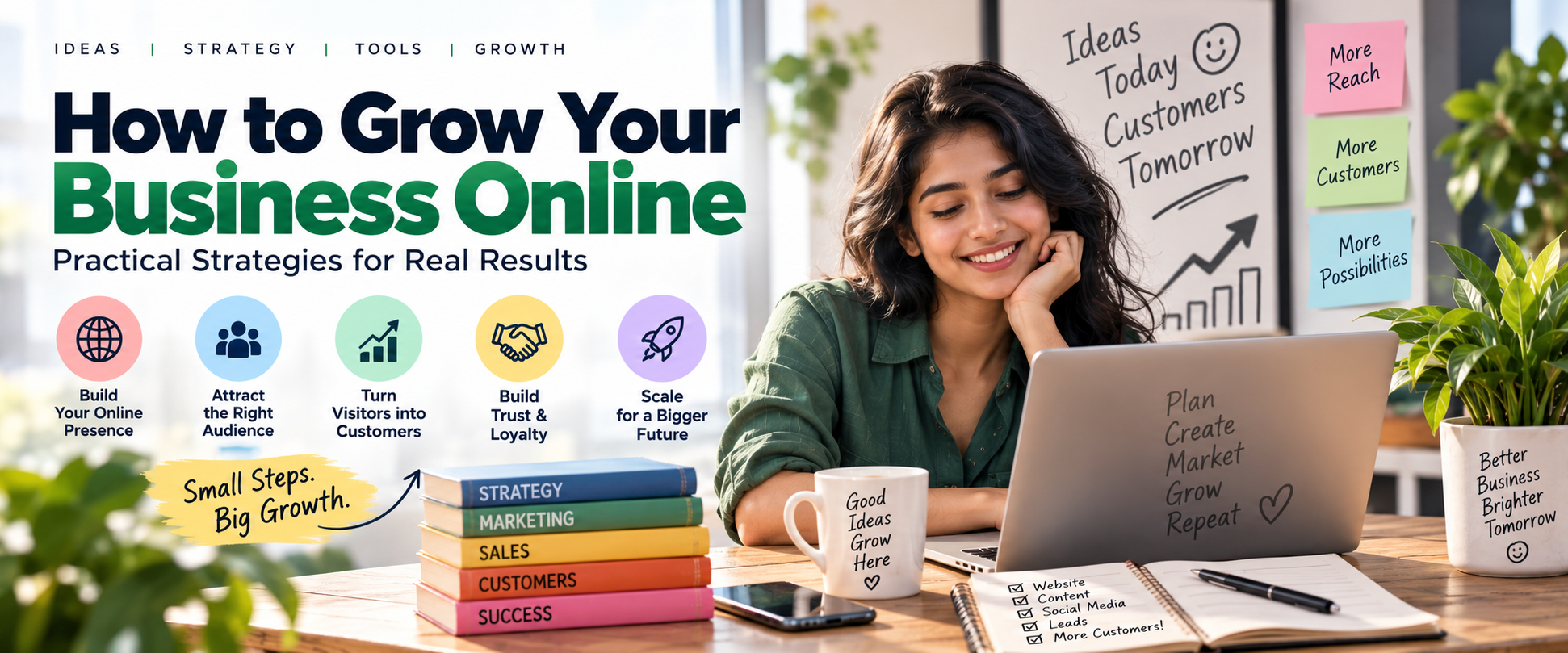
How to Grow Your Business Online: A Practical Guide for 2026
How to Grow Your Business Online: A Practical Guide for 2026
Growing a business online can feel overwhelming.
There are websites, social media, Google searches, online advertising, WhatsApp, email marketing, content creation, customer reviews, and dozens of other things competing for your attention. Many business owners know they need an online presence, but they don't know where to start or which activities will actually bring customers.
The good news is that you don't need to do everything at once.
A successful online business is usually built through a combination of simple things done consistently: having a clear offer, creating a professional online presence, reaching the right audience, building trust, and making it easy for people to contact or buy from you.
Whether you run a local shop, service company, ecommerce store, consultancy, agency, restaurant, travel business, or startup, the internet can help you reach customers beyond your immediate location.
In this guide, we'll look at practical ways to grow your business online, even if you're starting with a limited budget.
1. Start With a Clear Business Offer
Before spending money on advertising or social media, make sure people can understand what your business actually offers.
A common mistake is trying to sell everything to everyone.
For example, instead of saying:
"We provide digital solutions for businesses."
You could say:
"We build affordable websites and mobile apps for small businesses."
The second statement is easier to understand.
Your online presence should quickly answer three questions:
What do you sell?
Who is it for?
Why should someone choose you?
Think about the problem your product or service solves.
If you run a digital marketing agency, your customers may not actually want "SEO services." They may want more website visitors, leads, calls, and sales.
If you sell fitness products, customers may not simply want equipment. They may want convenient ways to exercise at home.
The clearer your offer is, the easier it becomes to create your website, advertisements, social media content, and sales messages.
2. Build a Professional Website
Your website is often one of the first places a potential customer goes after discovering your business.
It doesn't necessarily need to be complicated.
A small business website can start with a few important pages:
Home
About Us
Products or Services
Contact
FAQs
Testimonials or Reviews
Privacy Policy and other required business information
Your homepage should immediately communicate what you do.
Don't make visitors search through several pages to understand your business.
Include a clear call to action such as:
Call Now
Get a Quote
Book an Appointment
Request a Demo
Shop Now
Send an Enquiry
Contact Us on WhatsApp
Your website should also work properly on mobile phones. A large percentage of online visitors use smartphones, so a website that looks good only on a desktop can lose potential customers.
Speed matters too. If your website takes too long to load, visitors may leave before they see your offer.
3. Create and Optimize Your Google Business Profile
If you operate a local business, appearing when people search for services in your area can be extremely valuable.
For example, someone might search for:
"dentist near me"
"best hotel in Delhi"
"digital marketing agency in Gurgaon"
"AC repair near me"
"restaurants near me"
A properly maintained Google Business Profile can help your business appear in local search and map results.
Make sure your profile contains accurate information, including:
Business name
Address
Phone number
Website
Opening hours
Business category
Services
Photos
Products where relevant
Regularly add genuine photos and keep your information updated.
Customer reviews are also important for building trust. Encourage satisfied customers to leave honest reviews. Never create fake reviews simply to make your business look better.
Respond professionally to both positive and negative feedback.
4. Use Social Media Strategically
You don't have to be active on every social media platform.
Choose the platforms where your customers actually spend time.
For example, a visual product business may benefit heavily from Instagram, while a B2B company may find LinkedIn more relevant.
The important thing is consistency.
Instead of posting randomly, create a simple content plan.
You could use a combination such as:
Educational Content
Teach people something useful related to your industry.
Examples:
How to choose the right product
Common mistakes customers make
Tips for saving money
Industry explanations
Step-by-step guides
Product or Service Content
Show people what you offer.
Explain the features, benefits, pricing structure, use cases, or results customers can expect.
Behind-the-Scenes Content
Show the people and process behind your business.
Customers often connect with businesses more easily when they can see the human side.
Customer Stories
With permission, share testimonials, experiences, case studies, or completed projects.
Entertainment and Trends
Relevant short videos, relatable posts, trends, and creative content can help expand your reach.
The goal isn't simply to collect followers.
The goal is to build attention and eventually turn that attention into enquiries, customers, and repeat business.
5. Create Content That Answers Customer Questions
One of the most effective long-term ways to grow online is content marketing.
Think about the questions your customers ask before purchasing from you.
If you sell laptops, people may search for:
"Which laptop is best for office work?"
"What RAM do I need for video editing?"
"How much storage do I need?"
If you sell travel packages, potential customers might search:
"Best time to visit Dubai."
"How much does a Singapore trip cost?"
"What documents are required for a visa?"
These questions can become blog posts, videos, social media posts, FAQs, or guides.
Instead of constantly telling people to buy from you, provide useful information.
Over time, useful content can bring people to your website through search engines and social media.
6. Focus on SEO
Search Engine Optimization, commonly called SEO, helps your website become more discoverable in search engines.
SEO isn't just about adding keywords to a page.
Good SEO starts with understanding what potential customers are searching for.
For example, a company selling website development services might target topics such as:
Website development company
Website development cost
Ecommerce website development
Business website design
Website maintenance services
Create useful pages around topics relevant to your customers.
Pay attention to:
Page titles
Meta descriptions
Headings
Website content
Internal links
Image optimization
Website speed
Mobile usability
Clear URLs
Helpful FAQs
Don't write content purely for search engines.
Write for people first.
If visitors find your content useful, they are more likely to explore your website and contact your business.
7. Use Short-Form Video
Video has become one of the most accessible ways for businesses to attract attention online.
You don't need an expensive studio to begin.
A smartphone, good lighting, clear audio, and useful ideas can be enough.
Create short videos around topics your customers care about.
For example:
A restaurant can show food preparation, popular dishes, customer experiences, and offers.
A clothing store can show outfit combinations, new arrivals, styling tips, and product demonstrations.
A software company can create tutorials and quick tips.
A travel company can show destinations, hotel experiences, travel tips, and itinerary ideas.
The key is to provide a reason for someone to stop scrolling.
Start with a strong opening.
Instead of:
"Today we're going to talk about digital marketing."
Try:
"Getting website traffic but no enquiries? Here are three things you should check."
The second approach creates curiosity and addresses a specific problem.
8. Build an Email and WhatsApp Customer List
Social media platforms can help you reach people, but you don't control the platform.
Your own customer database is different.
With permission, collect customer contact information and use it responsibly.
Depending on your business, this could include:
Email addresses
WhatsApp contacts
Previous customers
Enquiries
Newsletter subscribers
Product buyers
You can then send useful updates, offers, new product announcements, reminders, educational content, and other relevant messages.
However, don't bombard people with promotional messages every day.
People are more likely to stay connected when your messages provide genuine value.
For example, an ecommerce business could send:
"New summer collection is now available."
A service company could send:
"Here are five things to check before renewing your website."
A travel company could send:
"Planning a trip this summer? Here's a checklist of documents to prepare."
Useful communication keeps your business memorable without constantly pushing a sale.
9. Try Paid Advertising
Organic growth can take time.
Paid advertising can help businesses reach potential customers faster.
Popular advertising platforms include search advertising and social media advertising.
Search ads can be useful when someone is actively looking for a product or service.
For example:
"Website developer near me"
"Visa consultant Delhi"
"Buy running shoes online"
Social media advertising works differently. It can help introduce your product or service to people based on factors such as interests, demographics, location, and online behavior, depending on the platform and available targeting options.
Start with a controlled budget.
Don't spend a large amount simply because you want more sales.
Instead:
Choose one product or service.
Define your target audience.
Create a clear advertisement.
Send visitors to a relevant landing page.
Track enquiries and sales.
Improve the campaign based on results.
The goal isn't to get the cheapest clicks.
The goal is to generate valuable customers at a sustainable cost.
10. Create Strong Landing Pages
Sending every advertisement to your homepage isn't always the best approach.
A landing page should focus on one particular offer.
For example, if you're advertising website development services, your landing page might contain:
Service overview
Benefits
Portfolio
Pricing starting point
Customer testimonials
FAQs
Contact form
WhatsApp button
Call-to-action
The page should make the next step obvious.
Remove unnecessary distractions.
If someone clicks an advertisement for "Restaurant Website Development," they should immediately see information about restaurant website development rather than a generic list of twenty different services.
11. Build Trust Online
People don't buy simply because a business exists.
They buy when they feel confident.
Trust can come from many places.
Show:
Real customer reviews
Testimonials
Portfolio examples
Business information
Clear contact details
Professional branding
Secure payment options
Transparent policies
Frequently asked questions
Real photographs where appropriate
If you have completed projects, show them.
If customers have achieved useful results, share genuine case studies.
If you have industry certifications or memberships that are relevant, display them accurately.
Avoid exaggerated promises.
Statements such as "100% guaranteed results" can create unrealistic expectations and damage credibility.
12. Make Your Business Easy to Contact
Imagine someone discovers your business at 11 PM and wants to ask a question.
Can they contact you?
Your website should make communication simple.
Depending on your business, consider adding:
Phone number
Contact form
Appointment booking
Live chat
Social media messaging
Don't make visitors fill out a long form unless you actually need all that information.
A simple enquiry form might ask for:
Name
Phone/email
Requirement
Preferred contact method
The easier it is to contact you, the fewer potential customers you'll lose because of unnecessary friction.
13. Respond Quickly to Leads
Getting leads is only half the job.
Following up is equally important.
A potential customer may contact several businesses at the same time.
If one company responds quickly and another responds two days later, the first company may get the opportunity to continue the conversation.
Create a simple lead-management process.
Record:
Customer name
Contact information
Requirement
Date of enquiry
Source of lead
Follow-up date
Current status
Even a spreadsheet can work when you're starting.
As the business grows, you can move to a CRM system.
14. Use Customer Reviews as Marketing Assets
Reviews are more than stars on a business listing.
With permission, genuine customer feedback can become content.
You can turn a review into:
Social media graphics
Website testimonials
Case studies
Short videos
Email content
Product pages
Don't edit reviews in a way that changes their meaning.
Authentic customer experiences are more valuable than perfectly polished marketing language.
15. Build a Referral System
Your existing customers can become one of your strongest sources of new business.
If someone is happy with your service, they may recommend you to friends, colleagues, or other businesses.
You can create a simple referral program where appropriate.
For example:
"Refer a customer and receive a discount on your next service."
The exact incentive depends on your business model.
But don't overlook the simplest approach: provide excellent service and actively ask satisfied customers if they know anyone who could benefit.
16. Track What Is Actually Working
One of the biggest advantages of online marketing is that you can measure many activities.
Don't judge your marketing only by likes and followers.
Track meaningful numbers such as:
Website visitors
Leads
Calls
WhatsApp enquiries
Sales
Conversion rate
Advertising cost
Cost per lead
Customer acquisition cost
Repeat purchases
Revenue
For example, imagine you spend ₹10,000 on advertising and generate 50 enquiries.
That means your average cost per enquiry is ₹200.
But the more important question is how many of those enquiries became customers.
If five customers purchased and generated ₹50,000 in revenue, you have much more useful information than simply knowing that your advertisement received 1,000 clicks.
17. Don't Try Everything at Once
This is one of the most important lessons for small businesses.
You don't need:
Five social media accounts
Ten advertising campaigns
A huge website
Hundreds of blog posts
Thousands of followers
on day one.
Start with a simple system.
For example:
Month 1
Build or improve your website, Google Business Profile, social media profiles, and basic tracking.
Month 2
Start publishing useful content and short videos consistently.
Month 3
Test a small paid advertising campaign.
Month 4
Analyze results and improve the activities generating the best business outcomes.
This approach is easier to manage and makes it easier to understand what's working.
18. Common Online Growth Mistakes to Avoid
Many businesses make the same mistakes when trying to grow online.
Buying Fake Followers
A large follower count doesn't automatically create customers. Fake followers can also make engagement statistics less useful.
Copying Competitors
Research competitors, but don't simply copy their website, branding, content, or strategy.
Find your own positioning.
Running Ads Without Tracking
If you don't know where your enquiries come from, you can't confidently decide where to invest more.
Ignoring Mobile Users
Always test your website on smartphones.
Posting Without a Strategy
Random posts may create activity without creating business results.
Giving Up Too Quickly
SEO, content marketing, social media, and brand building can take time.
At the same time, don't continue an activity indefinitely without measuring its results. Give strategies enough time to produce meaningful data, then improve them.
19. A Simple Online Growth Strategy
If you're starting from scratch, here's a practical roadmap.
Step 1: Define Your Target Customer
Write down who you want to serve.
Consider their location, needs, budget, problems, and buying behavior.
Step 2: Create Your Online Foundation
Set up:
Website
Google Business Profile if applicable
Social media profiles
Business email
WhatsApp or another communication channel
Step 3: Create Useful Content
Publish answers to questions your customers ask.
Start with one or two pieces of quality content each week.
Step 4: Build Trust
Collect genuine reviews, publish useful information, and showcase your work.
Step 5: Start Lead Generation
Use SEO, social media, referrals, partnerships, or paid advertising.
Step 6: Follow Up
Create a process so that enquiries don't disappear.
Step 7: Measure
Track leads, sales, costs, and conversion rates.
Step 8: Improve
Put more effort into the channels producing meaningful results and improve the weaker parts of your funnel.
20. The Real Secret to Growing a Business Online
There isn't one magic trick that works for every business.
Online growth usually comes from getting several fundamentals right and improving them over time.
You need a clear offer.
You need visibility.
You need useful content.
You need trust.
You need a simple way for customers to contact or buy from you.
And you need a system for measuring what happens after someone discovers your business.
The businesses that grow online aren't necessarily the ones posting the most or spending the most money.
They are often the ones that understand their customers, communicate clearly, provide a good experience, and consistently improve their marketing.
Start small.
Choose one audience.
Focus on one or two marketing channels.
Create useful content.
Track the results.
Talk to your customers.
Then improve the process.
Your website, social media pages, advertisements, and content are not separate pieces of your business. Together, they form a digital journey that takes someone from discovering your brand to trusting you and eventually becoming a customer.
That's the foundation of sustainable online business growth.

Comments (0)
No comments yet. Be the first to comment below!
Leave a Comment
Your email address will not be published. Required fields are marked *